


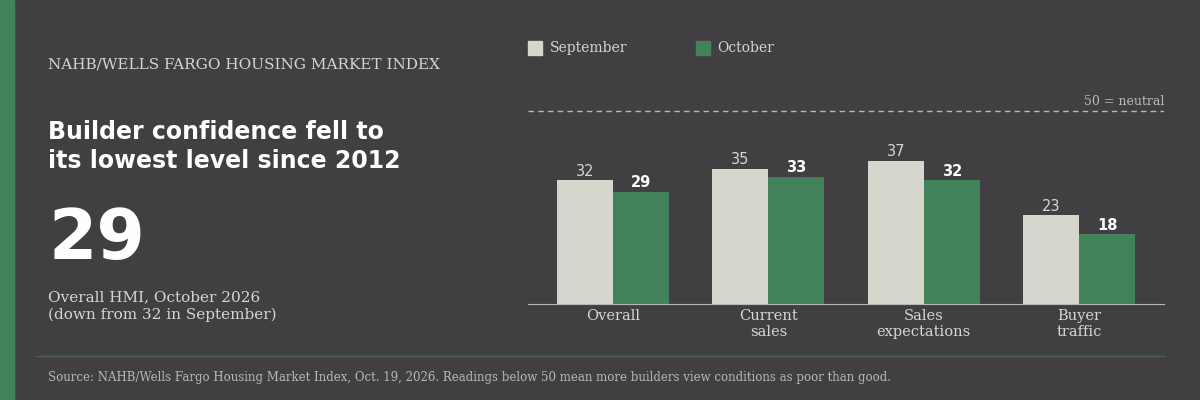
Home builders haven't been this gloomy in 14 years. The NAHB/Wells Fargo Housing Market Index (HMI) slipped three points to 29 in October, its weakest reading since June 2012, as mortgage rates pushed back above 7% and buyers stepped away.
Any reading below 50 means more builders see conditions as poor than good. At 29, the industry is well into pessimistic territory, and the details underneath the headline number look just as soft.
Every part of the index fell
All three components of the HMI declined in October, and buyer traffic took the hardest hit. NAHB says traffic is at its lowest since April 2012, setting aside the brief collapse at the start of the pandemic.
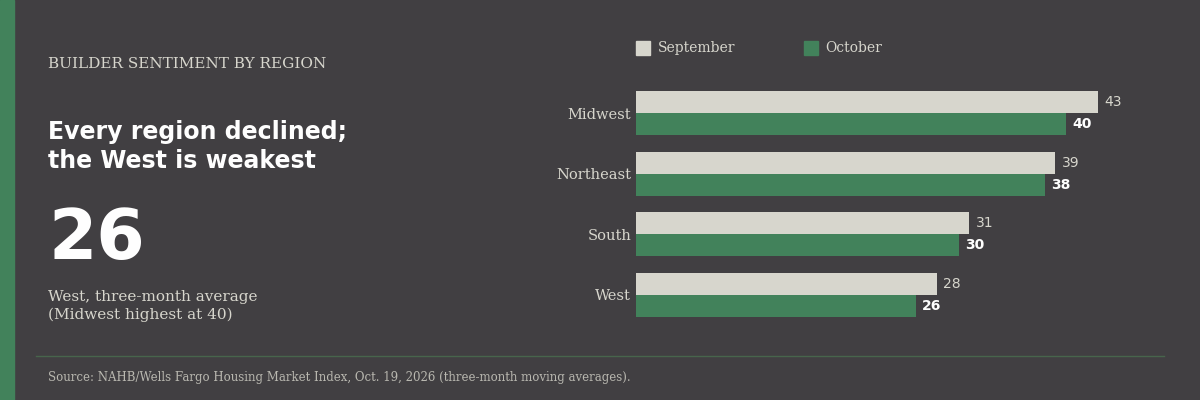
The weakness is national. On a three-month moving average, the West is softest at 26, followed by the South at 30, the Northeast at 38 and the Midwest at 40. The Midwest stands out as a relative bright spot, with single-family permits up 2.9%.
Rates above 7% are pricing buyers out
NAHB points first to borrowing costs. The average 30-year fixed mortgage rate has stayed above 7% since late September, and Homes.com reports analysts expect a Federal Reserve rate hike this month. Fannie Mae now projects 30-year rates averaging 7.5% in 2027.
Higher rates raise monthly payments, which can reduce what buyers are able to afford. Lennar, the second-largest U.S. builder, said in September that nearly half of visitors in many of its markets can't immediately qualify for a mortgage. NAHB also points to higher gas prices, stubborn inflation and weaker consumer confidence.
Builders face pressure on the cost side too. NAHB cites pricier construction loans, materials and diesel, plus tighter labor and lot supply. More than a third of builders reported immigration enforcement activity in their areas last month, which they say delayed projects and kept some legal workers off job sites.
The current reading is low, but not Great Recession low. The index bottomed at 9 during that downturn and stayed in the low teens until 2012. October does mark the 30th straight month below 50.
Builders are cutting prices to move homes
In October, 43% of builders cut prices, the highest share in NAHB's 2020–2026 tracking. The average cut held at 6% for a seventh straight month.
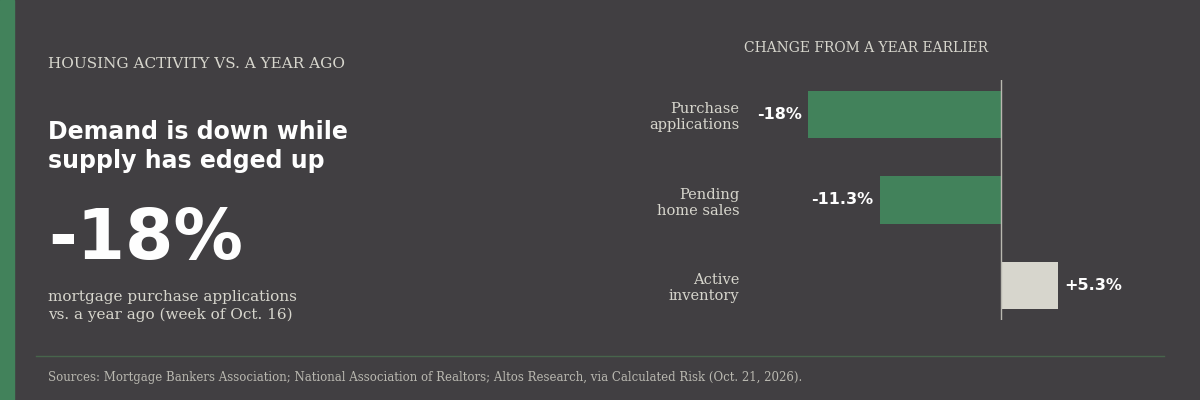
Incentives are even more widespread. 65% of builders used them in October, the 19th consecutive month that at least 60% have done so. According to Homes.com, these often include mortgage-rate buydowns, credits and other extras.
Homes.com notes that incentives come at the expense of builder profit margins, and reports that Lennar's profits have remained under pressure.
The rest of the housing data agrees
Builder sentiment isn't an outlier. Weekly and monthly data compiled by Bill McBride at Calculated Risk show demand falling while supply edges up, a combination he says could put pressure on home prices.
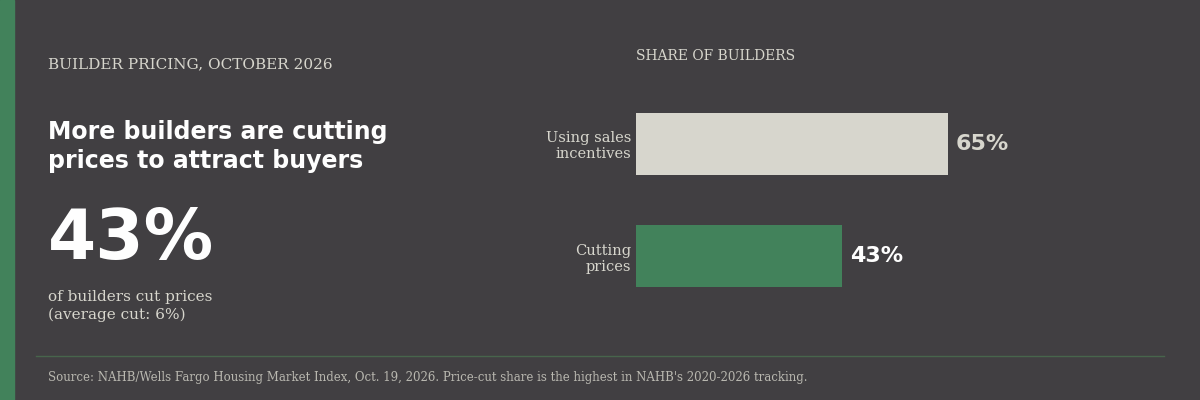
Applications declined even in a week when rates dipped slightly, which MBA attributed to higher rates pricing buyers out. NAR's chief economist Lawrence Yun tied September's weakness to rapidly rising rates. With rates near 7.5%, McBride wrote that existing-home sales will likely slow in the coming months; actual outcomes may differ.
Why housing matters beyond housing
Housing is one of the most interest-rate-sensitive parts of the economy. As borrowing costs stay elevated, Anchor Capital notes that activity is slowing not only in new construction and home sales but also in related industries.
Because of that sensitivity, housing is often watched as an early signal of broader economic trends. If the weakness persists, it could have implications for consumer spending, construction activity and overall economic growth. Housing data alone does not determine the economic outlook, however, and conditions can change as rates and other factors shift.
What it could mean
These conditions may give some qualified buyers more room to negotiate, particularly on new construction, where many builders are offering price cuts and incentives. Depending on its terms, a rate buydown could lower a monthly payment more or less than a price cut of similar cost, so buyers may want to compare options with a lender.
For homeowners considering a sale, rising inventory and softer demand could mean more competition from other listings and a longer time on market.
For investors, NAHB and Homes.com describe builders contending with both discounting and higher costs, which can weigh on margins. Recent data show relatively more strength in lower-cost markets such as the Midwest, though regional trends can change quickly.
The direction of mortgage rates remains a key factor to watch. Forecasts, including Fannie Mae's projection of 7.5% average rates in 2027, are estimates and may not prove accurate.
The bottom line
October's data points in the same direction: builder confidence at a 14-year low, fewer buyers coming through the door, and more builders turning to price cuts and incentives. Mortgage applications, pending sales and inventory figures tell a similar story of softer demand and somewhat more supply.
How long these conditions last will likely depend on the path of mortgage rates, construction costs and consumer confidence, none of which can be predicted with certainty. Because housing is closely tied to the broader economy, it is a sector worth watching in the months ahead.
We will continue to monitor these trends. If you have questions about how changing market conditions may relate to your own financial situation, please reach out.
Disclosure
This content was generated utilizing the help of AI research and is intended for informational purposes only. Please consult a qualified professional for personalized advice. The information provided is for general educational purposes only and should not be construed as mortgage advice. Craig Watkins is not a mortgage professional and does not offer mortgage products or services. Any decisions regarding mortgages should be made in consultation with a qualified mortgage lender or professional. The views expressed are based on publicly available information and are not intended as individualized financial advice.
Sources
Builder Sentiment Falls on Rising Rates, NAHB, Oct. 19, 2026
Homebuilder confidence falls to lowest level since 2012, Homes.com, Oct. 19, 2026
High Frequency Data: Housing Slump Deepens, Calculated Risk, Oct. 21, 2026
Homebuilder Confidence Falls to Lowest Level Since 2012, Anchor Capital